We’ve crossed the AI threshold. Now the question is: who are you on the other side?
AI is here and it’s woven into workflows, decisions, customer experiences, performance reviews, and knowledge work.
Tasks once considered “strategic” have been automated. Judgment we once thought uniquely human is simulated with startling accuracy. In this moment, leaders are asking the wrong question.
The question is not: “What can AI do?”
It’s: “What will become of leadership as AI takes on more of the work we used to define ourselves by?”
This is the identity inflection point. And it reveals something we’ve ignored for decades:
>>We built leadership that machines can now imitate.
>>We did not build leadership anchored, rooted, grounded in what machines can never become.
But the antidote is both the promise- and the urgency- of what Dr. Natalie Pickering calls Identity-First Leadership, Identity-First Teaming, and Identity-First Coaching.
We Trained Leaders to Think Like Algorithms. AI Just Perfected It.
For years, leadership development has elevated performance efficiency:
• faster decisions
• cleaner metrics
• predictable behaviors
• scalable models
• reduced ambiguity
The gaps of optimizing leaders exclusively to algorithmic performance have been exposed. Task-only leadership simply translates to AI is doing that work better. Cheaper. More consistently. Tirelessly.
The leadership identity crisis has been revealed, in large part by the advance of AI. Leaders and their organizations who defined their value by competence alone now find themselves sharing a lane with machines. And machines are gaining speed.
According to the McKinsey Global Institute, as much as 50% of current managerial and leadership work activities-especially those that are routine, analytical, or administrative-could be automated with existing technology.
But the same research emphasizes one thing AI cannot do: embody identity, integrity, or coherence.
Those remain profoundly human.
AI Doesn’t Replace Leaders. But Unclear Identity Does.
One specific tension in the AI meets human landscape change is the introduction of pressure by ethical and efficient use of AI.
Pressure exposes the nuts and bolts of leader identity.
And unclear identity, when unconsidered and unintegrated, collapses under pressure.
When leaders are disconnected from their values, story, and purpose, AI optimization becomes a simple shortcut or a threatening takeover.
Other ways AI can illuminate less helpful leadership patterns and their resulting friction felt by teams include:
- Reactive leadership: Leaders lose their internal compass, lose people-centric connection, and rely exclusively on algorithms to determine direction.
- Performative authenticity: Leaders sound polished but feel hollow; communication becomes synthetic instead of human.
- Fragmented culture: When leaders over-defer to data, teams lose the human through-line that fosters trust.
- Meaning erosion: People begin feeling like cogs in a machine optimized for efficiency rather than purpose.
The necessarily human leader element here prioritizes ethics and integrity, recognizes ethical drift, notes the discomfort when processes and pursuits become disconnected from values, meaning, and purpose. The identity-first leader is grounded in value-supported decision-making, which AI cannot replace.
The Human Edge Isn’t IQ. It’s I-D.
AI can replicate many forms of intelligence. But it cannot replicate identity or leader identity clarity- the internal coherence between:
• who you are
• what you value
• how you lead
• and why you decide, team, mentor, motivate and yes, perform
This is what your team follows, trusts, and appreciates. Research confirms that trust, satisfaction, and perceived authenticity decline in AI interactions–especially in contexts where human understanding, empathy, or moral judgment matter (e.g. support, customer service, mentorship, culture). People detect the subtle dissonance, even if they can’t articulate it.
AI can produce language that sounds empathetic. It cannot produce presence.
It can generate options. It cannot generate meaning.
It can optimize decisions. It cannot carry responsibility.
Identity-First Leadership: The Both/And Model for the AI Era
AI isn’t the enemy of leadership. AI is the mirror that forces leadership back to its identity roots.
Identity-First Leadership says:
You integrate AI into your leadership identity
without outsourcing the parts that are fundamentally human
and without performing a false choice between human or machine (back to: it’s here to stay).
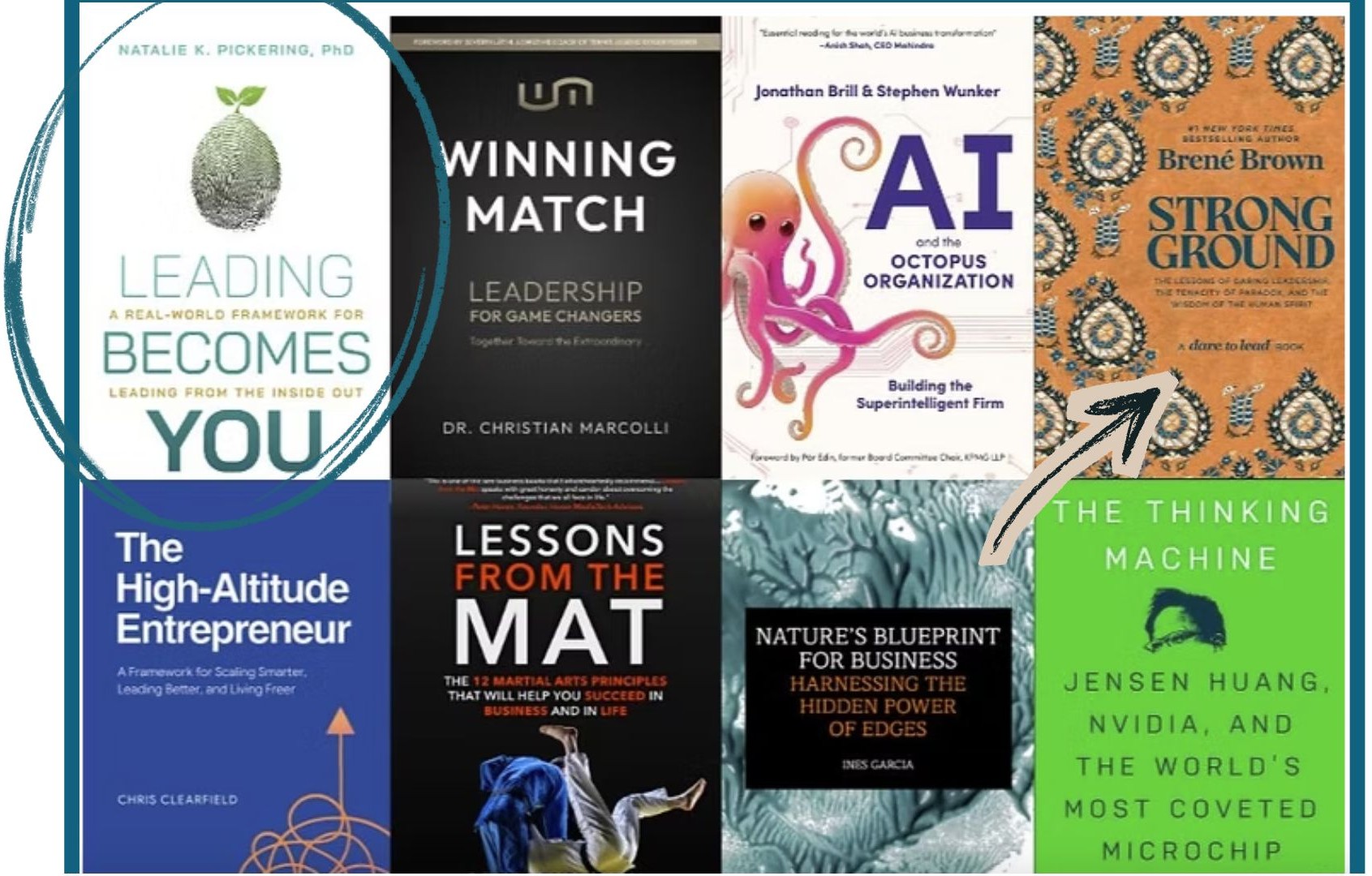
It’s what Dr. Natalie Pickering’s book, Leading Becomes You, calls “ANDlightenment” – the life and leadership necessity of the both/and:
Human coherence & machine intelligence = modern leadership capability.
Identity clarity is what keeps your leadership grounded in who you are.
Connection is what keeps your leadership human in how you show up with your team.
Coherence is what makes your presence trustworthy in a digital age.
Identify clarity coherence, which considers the how, when, and why AI plays, is your new competitive edge.
Why Identity Clarity Is Now a Strategic Imperative
Recent research by Gartner, Inc. highlights a growing reality across organizations undergoing digital transformation:
Identity, trust, and human capability are becoming just as important as technological capability.
Gartner’s findings show that companies reshaping their identity and leadership practices—shifting from rigid roles to more fluid, capability-based ecosystems—are better positioned to navigate digitization and change.
When leaders lack clarity about who they are and what they stand for, findings indicate they are more likely to struggle with inconsistent direction, change fatigue, and organizational resistance to new technologies.
In contrast, leaders who are grounded in identity and coherence are better able to create alignment, trust, and human readiness for transformation. Identity clarity helps leaders say:
• “This is who I am, regardless of the technology.”
• “This is how I make meaning, not just decisions.”
• “This is what matters, even when systems scale and speed up.”
That steadiness becomes the antidote to technological overwhelm–and the anchor teams look to when everything else feels accelerated and ambiguous.
How can identity-first leadership become your strategic advantage in the age of AI?
Cited Research:
Deloitte. 2024 Global Human Capital Trends: Thriving Beyond Boundaries. Deloitte Insights, 2024.
Waytz, Adam, Julian De Freitas, and Mina Cikara. Empathy Toward Artificial Intelligence Versus Human Experiences. Harvard Business School Working Paper, No. 24–011, 2024.
Purington, Amanda, et al. “Human–Chatbot Communication: A Systematic Review of Psychological Studies.” AI & Society, 2025.
Lund, Susan, et al. The Future of Work After COVID-19. McKinsey Global Institute, McKinsey & Company, Feb. 2021.
Gartner, Inc. “Gartner Survey of Over 2,400 CIOs Reveals That 45% of CIOs Are Driving a Shift to Co-Ownership of Digital Leadership.” Gartner, 17 Oct. 2023.
Gartner, Inc. “Gartner Marketing Survey Finds 84% of Business Leaders and Employees Agree Their Company’s Identity Must Change Significantly to Achieve Objectives.” Gartner, 4 June 2024.
photo credit: Mohammad Usman via Pixabay